Height and diameter performances in afforestation of Taurus cedar and Crimean juniper seedlings: A case study from southern Turkey
DOI:
https://doi.org/10.21750/REFOR.20.04.130Keywords:
Diameter, Height, Plantation, Species, VariationAbstract
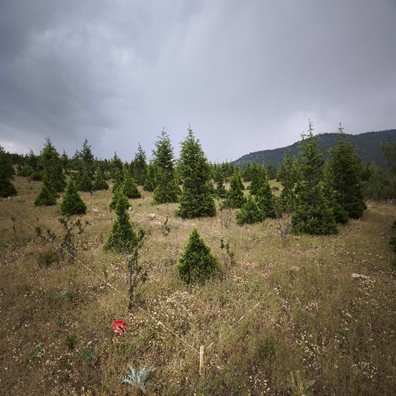
The present study was carried out in 16rd year afforestation sampled from southern Turkey of Taurus cedar (Cedrus libani A. Rich) and Crimean juniper (Juniperus excelsa Bieb.). Variation, competition and correlation were examined based on seedling height and stem diameter at base data collected from two samples areas 500 m2 each. Growth performances were different at the areas for the species, while averages of Taurus cedar (223.6 for height and 65.3 mm for stem diameter at base) had higher than Crimean juniper (106 cm and 58.5 mm) in total areas. The results emphasized importance of species selection in afforestation. Significant (p<0.05) differences between areas and species were found according to results of analysis of variance. Positive and significant phenotypic correlation (p<0.05, r>0.52) was estimated between the characteristics in both species and areas. It could be used for tending in afforestation areas.
Downloads
References
Anonymous (2025) Forest inventory of Turkey. General Directorate of Forestry of Turkey, Ankara. https://www.ogm.gov.tr
Bilir N (2004) Phenotypic age-age correlations for height, diameter and volume in Cedrus libani A. Rich. Journal of Forestry Faculty of Süleyman Demirel University, A(1):12-18.
Bilir N, Yazıcı N, Özel HB (2018) Examination of Taurus cedar (Cedrus libani) afforestation in Isparta province of Turkey. International Conference Reforestation Challenges, June 20-22, 2018, Belgrade, Serbia, Book of Abstracts, 33.
Boydak M (2003) Regeneration of Lebanon cedar (Cedrus libani A. Rich.) on karstic lands in Turkey. Forest Ecol Manage 178: 231-243. https://doi.org/10.1016/S0378-1127(02)00539-X DOI: https://doi.org/10.1016/S0378-1127(02)00539-X
Eler U, Keskin S, Örtel E (1993) Determination of tlıe quality cfasses of Lebanon cedar (Cedrus libani A. Rich.) seedlings. Journal of Forest Research Institute 240: 81-105.
Eser Y (2021) Morphological characteristics of containerized and bare-root seedlings in Juniperus excelsa and J. foetidissima. Fresen Environ Bull 30: 8351-8355. https://www.prt-parlar.de/
Eser Y (2025) Growth performance in afforestations of Taurus cedar, Anatolian black pine and Crimean juniper. Theoretical and Applied Forestry 5: 1 (In press).
Eser Y, Gülcü S (2019) The effects of growing density and fertilization on morphological seedling characteristics of Crimean juniper (Juniperus excelsa Bieb.). Turkish Journal of Forestry 20(1): 15-19. https://doi.org/10.18182/tjf.483157 DOI: https://doi.org/10.18182/tjf.483157
Falconer DS (1989) Introduction to Quantitative Genetics. 3rd Edition, Longman Scientific and Technical, New York.
Farjon A (2005) A monograph of Cupressaceae and Sciadopitys. Kew (United Kingdom): Royal Botanic Gardens.
Özbey AA, Bilir N (2024) Seedling morphology and quality in Crimean juniper (Juniperus excelsa Bieb.). Agriculture and Forestry 70 (3): 163-171. https://doi.org/10.17707/AgricultForest.70.3.11 DOI: https://doi.org/10.17707/AgricultForest.70.3.11
SPSS (2011) IBM SPSS Statistics for Windows, Version 20.0., NY: IBM Corp
Yazıcı N (2018) Effect of species and environmental factors on growth performances in afforesration of Cedrus libani and Pinus brutia. Fresen Environ Bull 27: 6913-6917. https://www.prt-parlar.de/
Yazıcı N, Babalık AA, Bilir N (2022) Effect of slope on growth of a Taurus cedar (Cedrus libani A. Rich.) afforestation: A case study from Dinar. Anatolian Journal of Forest Research 8(2): 1-5. https://doi.org/10.53516/ajfr.1137004 DOI: https://doi.org/10.53516/ajfr.1137004
Yazıcı N, Turan A (2016) Effect of forestry afforestation on some soil properties: A case study from Turkey. Fresen Environ Bull 25: 2509-2513. https://www.prt-parlar.de/
Downloads
Published
Issue
Section
License

This work is licensed under a Creative Commons Attribution 4.0 International License.
Authors who publish with this journal agree to the following terms:
- Authors retain copyright and grant the journal right of first publication with the work simultaneously licensed under a Creative Commons Attribution License CCBY that allows others to share the work with an acknowledgement of the work's authorship and initial publication in this journal.
- Authors are able to enter into separate, additional contractual arrangements for the non-exclusive distribution of the journal's published version of the work (e.g., post it to an institutional repository or publish it in a book), with an acknowledgement of its initial publication in this journal.
- Authors are permitted and encouraged to post their work online (e.g., in institutional repositories or on their website) prior to and during the submission process, as it can lead to productive exchanges, as well as earlier and greater citation of published work (See The Effect of Open Access).
How to Cite