Different nursery techniques in the production of Quercus crassifolia
DOI:
https://doi.org/10.21750/REFOR.20.01.127Keywords:
Containers, Fertilization, Oak, SubstratesAbstract
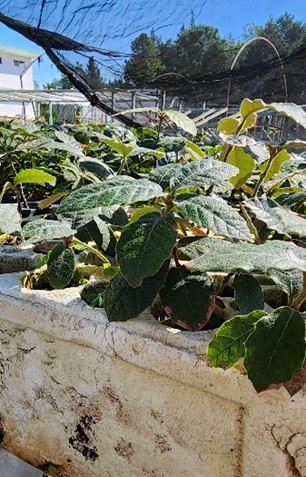
Mexico is the country with the highest number of species of the genus Quercus, but there has been little research on their propagation in nurseries. Quercus crassifolia is distributed across more than 50% of the national territory; however, no studies have been conducted to document its morphological growth and plant quality in nurseries for reforestation and forest restoration. Some of the key factors in plant production, principally in a technified system, are the selection of containers, substrates, and fertilizer doses. This study therefore evaluated two container sizes, two mixtures of organic substrates, and two doses of controlled-release fertilizer. After nine months of growth in the nursery, morphometric parameters of the plants were recorded, and quality indices were determined based on these values. The results showed that container size, substrate choice, and fertilization dose all influenced the quality of the plant produced. With both fertilizer doses, the 25:25:50 substrate mixture of fresh pine sawdust, composted pine bark, and moss peat produced plants with the highest values of height, diameter, and shoot, root, and total dry biomass. Considering the factors evaluated, the use of 200 mL containers with the aforementioned substrate mixture and the addition of 7 g L-1 of controlled-release fertilizer will produce plants of Quercus crassifolia suitable quality for use in reforestation.
Downloads
References
Agro E, Zheng Y (2014) Controlled-release fertilizer application rates for container nursery crop production in Southwestern Ontario, Canada. Hortscience 49(11): 1414-1423. https://doi.org/10.21273/HORTSCI.49.11.1414 DOI: https://doi.org/10.21273/HORTSCI.49.11.1414
Aguilera-Rodríguez M, Aldrete A, Martínez-Trinidad T, Ordáz-Chaparro VM (2016) Producción de Pinus montezumae Lamb. con diferentes sustratos y fertilizantes de liberación controlada. Agrociencia 50(1): 107-118. https://scielo.org.mx/pdf/agro/v50n1/1405-3195-agro-50-01-107.pdf
Aldrete A, Sánchez-Velázquez JR, Aguilera-Rodríguez M, Cibrián-Tovar D, García-Díaz SE (2023a) Manual de buenas prácticas para el manejo de la salud de planta en viveros forestales. Universidad Autónoma Chapingo: Texcoco, México. 291 p.
Aldrete A, Sánchez Velázquez JR, Aguilera Rodríguez M, Rodríguez Trejo DA (2023b) Calidad de planta en viveros forestales. In: Aldrete, A, Sánchez-Velázquez JR, Aguilera-Rodríguez M, Cibrián-Tovar D, García-Díaz SE (eds.) Manual de buenas prácticas para el manejo de la salud de planta en viveros forestales. Chapingo-Estado de México, pp. 19-39.
Atzori G, Pane C, Zaccardelli M, Cacini S, Massa D (2021) The role of peat-free organic substrates in the sustainable management of soilless cultivations. Agronomy 11(6): 1236. https://doi.org/10.3390/agronomy11061236 DOI: https://doi.org/10.3390/agronomy11061236
Barrett GE, Alexander PD, Robinson JS, Bragg NC (2016) Achieving environmentally sustainable growing media for soilless plant cultivation systems-A review. Sci Hortic 212: 220-234. https://www.sciencedirect.com/science/article/pii/S030442381630471X DOI: https://doi.org/10.1016/j.scienta.2016.09.030
Benítez-Favela R, Prieto Ruíz JA, Madrid-Aispuro RE, Aguilar-Vitela JL, Domínguez Calleros PA, Salcido-Ruiz S. (2025) Growing Pinus maximartinezii Rzedowski in a nursery, in three types of containers: an endangered species endemic to Mexico. Agro Productividad 18(11): 37-45. https://doi.org/10.32854/hbbs9241 DOI: https://doi.org/10.32854/hbbs9241
Bilgin S (2019) Determination of seedling quality characteristics of stone pine (Pinus pinea L.), valonia oak (Quercus ithaburensis Decne. subsp. macrolepis (Kotschy) Hedge & Yalt.) and Turkey oak (Quercus cerris L.) seedlings. Turkish Journal of Forestry 20(4): 297-304. https://doi.org/10.18182/tjf.565999 DOI: https://doi.org/10.18182/tjf.565999
Chirino E, Vilagrosa A, Hernández EI, Matos A, Vallejo VR (2008) Effects of a deep container on morpho-functional characteristics and root colonization in Quercus suber L. seedlings for reforestation in Mediterranean climate. Forest Ecol Manag 256(4): 779-785. https://doi.org/10.1016/j.foreco.2008.05.035 DOI: https://doi.org/10.1016/j.foreco.2008.05.035
De Jesús Albino F, Ignacio Hernández R, Rodríguez Trejo DA, Mohedano Caballero L (2021) Quercus rugosa Née seedling quality in a forest nursery. Revista Mexicana de Ciencias Forestales 12(67): 147-167. https://doi.org/10.29298/rmcf.v12i67.967 DOI: https://doi.org/10.29298/rmcf.v12i67.967
Del Campo AD, Navarro RM, Ceacero CJ (2010) Seedling quality and field performance of commercial stocklots of containerized holm oak (Quercus ilex) in Mediterranean Spain: An approach for establishing a quality standard. New Forest 39: 19-37. https://doi.org/10.1007/s11056-009-9152-9 DOI: https://doi.org/10.1007/s11056-009-9152-9
Devetaković JR, Nonić M, Prokić B, Šijačić-Nikolić M, Popović V (2019) Acorn size influence on the quality of pedunculate oak (Quercus robur L.) one-year old seedlings. Reforesta 8: 17-24. http://dx.doi.org/10.21750/REFOR.8.02.72 DOI: https://doi.org/10.21750/REFOR.8.02.72
Dumroese RK, Pinto JR, Heiskanen J, Tervahauta A, McBurney KG, Page-Dumroese DS, Englund K (2018) Biochar can be a suitable replacement for sphagnum peat in nursery production of Pinus ponderosa seedlings. Forests 9: 232 https://doi.org/10.3390/f9050232 DOI: https://doi.org/10.3390/f9050232
Duque-Lazo J, Navarro-Cerrillo RM, Ruíz-Gómez FJ (2018) Assessment of the future stability of cork oak (Quercus suber L.) afforestation under climate change scenarios in Southwest Spain. Forest Ecol Manag 409: 444-456. https://doi.org/10.1016/j.foreco.2017.11.042 DOI: https://doi.org/10.1016/j.foreco.2017.11.042
Flores-Velázquez R, Fuentes-López ME, Quintanar-Olguín J, Tamarit-Urías JC (2013) Maching of four timber oak species from Sierra de Juarez, Oaxaca. Revista Mexicana de Ciencias Forestales 4(16): 22-33. http://www.scielo.org.mx/scielo.php?script=sci_arttext&pid=S2007-11322013000200003&lng=es&tlng=es
Fussy A, Papenbrock J (2022) An Overview of Soil and Soilless Cultivation Techniques-Chances, Challenges and the Neglected Question of Sustainability. Plants 11(9): 1153. https://doi.org/10.3390/plants11091153 DOI: https://doi.org/10.3390/plants11091153
Gabira MM, Silva RBG, Bortolheiro FPAP, Mateus CMD, Villas Boas RL, Rossi S, Girona MM, Silva MR (2021) Composted sewage sludge as an alternative substrate for forest seedlings production. iForest 14: 569-575. https://doi.org/10.3832/ifor3929-014 DOI: https://doi.org/10.3832/ifor3929-014
González-Alemán MA, Aguilera-Rodríguez M, Hernández-Díaz JC, Wehenkel C, Madrid-Aispuro RE, Prieto-Ruíz JA (2025) Growth of Pinus durangensis Mart. in response to substrate types and controlled-release fertilizer rates in a nursery. Revista Chapingo Serie Ciencias Forestales y del Ambiente 31: e24039. https://doi.org/10.5154/r.rchscfa.2024.09.039 DOI: https://doi.org/10.5154/r.rchscfa.2024.09.039
González-Elizondo MS, González-Elizondo M, Tena-Flores JA, Ruacho-González L, López-Enríquez IL (2012) Vegetación de la Sierra Madre Occidental, México: una síntesis. Acta Botánica Mexicana 100: 351-403. https://doi.org/10.21829/abm100.2012.40 DOI: https://doi.org/10.21829/abm100.2012.40
González-Orozco MM, Prieto-Ruíz JA, Aldrete A, Hernández-Díaz JC, Chávez-Simental JA, Rodríguez-Laguna R (2018) Nursery production of Pinus engelmannii Carr. with substrates based on fresh sawdust. Forests 9(11): 678. https://doi.org/10.3390/f9110678 DOI: https://doi.org/10.3390/f9110678
Gorgonio-Ramírez M, Clark Tapia R, Campos JE, Monsalvo Reyes A, Alfonso Corrado C (2017) Diversidad y estructura genética de Quercus crassifolia en sitios de manejo forestal y uso local en Sierra Juárez, Oaxaca. Madera y Bosques 23(2): 85-98. https://doi.org/10.21829/myb.2017.2321122 DOI: https://doi.org/10.21829/myb.2017.2321122
Grossnickle SC, MacDonald JE (2018) Seedling quality: History, application, and plant attributes. Forests 9(283): 1-23. https://doi.org/10.3390/f9050283 DOI: https://doi.org/10.3390/f9050283
Grossnickle SC, Ivetić V (2022) Root system development and field establishment: effect of seedling quality. New Forest 53: 1021-1067. https://doi.org/10.1007/s11056-022-09916-y DOI: https://doi.org/10.1007/s11056-022-09916-y
Gruda N (2009) Do soilless culture systems have an influence on product quality of vegetables?. Journal of Applied Botany and Food Quality 82: 141-147. https://doi.org/10.18452/9433
Heiskanen J, Ruhanen H, Himanen K, Kivimäenpää M, Silvan N (2024) Growth of Nordic container forest tree seedlings in some peatless and peat-reduced growing media. New Forest 55: 1499-1517. https://doi.org/10.1007/s11056-024-10048-8 DOI: https://doi.org/10.1007/s11056-024-10048-8
Hernández Quiroz NS, Badano EI (2017) Cambio climático y bosques de encinos. Ciencia 68(4): 70–75. https://www.revistaciencia.amc.edu.mx/images/revista/68_4/PDF/68_4_cambio_climatico_encinos.pdf
Hernández-Ramos J, Ángeles-Pérez G, Pérez-Miranda R, Reyes-Hernández VJ, Razo-Zárate R (2022) Morfometría de copa para Quercus crassifolia Humb. & Bonpl. y Quercus rugosa Née en Hidalgo, México. Ciência Florestal Santa Maria 32(3): 1418-1438. https://doi.org/10.5902/1980509865276 DOI: https://doi.org/10.5902/1980509865276
Hipp AL, Manos PS, González-Rodríguez A, Hahn M, Kaproth M, McVay JD, Valencia Avalos S, Cavender-Bares J (2017) Sympatric parallel diversification of major oak clades in the Americas and the origins of Mexican species diversity. New Phytologist 217: 1-13 https://doi.org/10.1111/nph.14773 DOI: https://doi.org/10.1111/nph.14773
Hussain A, Iqbal K, Aziem S, Mahato P, Negi AK (2014) A review on the science of growing crops without soil (Soilless Culture) – A novel alternative for growing crops. International Journal of Agriculture and Crop Sciences 7(11): 833-842. https://www.researchgate.net/publication/277017205_A_Review_On_The_Science_Of_Growing_Crops_Without_Soil_Soilless_Culture_-_A_Novel_Alternative_For_Growing_Crops
Jokanović D, Nikolić Jokanović V, Živanović K, Ilić M, Antanasijević N, Jovanović F (2024) Variability of morpho-anatomical traits of one-year-old Quercus sp. container seedlings. Reforesta 18: 22-33. https://doi.org/10.21750/REFOR.18.02.118 DOI: https://doi.org/10.21750/REFOR.18.02.118
Kremer A, Hipp AL (2020) Oaks: an evolutionary success story. New Phytol 226: 987-1011. https://doi.org/10.1111/nph.16274 DOI: https://doi.org/10.1111/nph.16274
Madrid-Aispuro RE, Cordova-Saucedo MD, Prieto-Ruíz JA, Aldrete A, Salcido-Ruiz S, Pérez-Luna A (2025) Growth of Quercus durifolia Seemen in substrates with peat, bark, sawdust and controlled-release fertilizer. Revista Mexicana de Ciencias Forestales 16(88): 75-97. https://doi.org/10.29298/rmcf.v16i88.1526 DOI: https://doi.org/10.29298/rmcf.v16i88.1526
Madrid-Aispuro RE, Prieto-Ruíz JA, Aldrete A, Hernández-Díaz JC, Wehenkel C, Chávez-Simental JA, Mexal JG (2020) Alternative substrates and fertilization doses in the production of Pinus cembroides Zucc. in nursery. Forests 11(1): 1-13. https://doi.org/10.3390/F11010071 DOI: https://doi.org/10.3390/f11010071
Mariotti B, Maltoni A, Chiarabaglio PM, Giorcelli A, Jacobs DF, Tognetti R, Tani A (2015a) ¿Can the use of large, alternative nursery containers aid in field establishment of Juglans regia and Quercus robur seedlings?. New Forest 46(5): 773-794. https://doi.org/10.1007/s11056-015-9505-5 DOI: https://doi.org/10.1007/s11056-015-9505-5
Mariotti B, Maltoni A, Jacobs DF, Tani A (2015b) Container effects on growth and biomass allocation in Quercus robur and Juglans regia seedlings. Scand J Forest Res 30(5): 401-415. https://doi.org/10.1080/02827581.2015.1023352 DOI: https://doi.org/10.1080/02827581.2015.1023352
Mariotti B, Martini S, Raddi S, Tani A, Jacobs DF, Oliet JA, Maltoni A (2020) Coconut coir as a sustainable nursery growing media for seedling production of the ecologically diverse Quercus species. Forests 11(5): 522. https://doi.org/10.3390/f11050522 DOI: https://doi.org/10.3390/f11050522
Mateo Sánchez JJ, Suarez Islas A, Capulín Grande J, Pacheco Trejo J, González de la Rosa L, Reyes Santamaría MI (2023) Use of primary industry wood waste for nursery plant production. Boletín de Ciencias Agropecuarias del ICAP 9: 26-33. https://doi.org/10.29057/icap.v9iEspecial.8977 DOI: https://doi.org/10.29057/icap.v9iEspecial.8977
Moradi S, Babapoor A, Ghanbarlou S, Kalashgarani MY, Salahshoori I, Seyfaee A (2024) Toward a new generation of fertilizers with the approach of controlled-release fertilizers: a review. J Coat Technol Res 21: 31-54. https://doi.org/10.1007/s11998-023-00817-z DOI: https://doi.org/10.1007/s11998-023-00817-z
Pascual S, Olarieta JR, Rodríguez-Ochoa R (2012) Development of Quercus ilex plantations is related to soil phosphorus availability on shallow calcareous soils. New Forest 43: 805-814. https://doi.org/10.1007/s11056-012-9337-5 DOI: https://doi.org/10.1007/s11056-012-9337-5
Paula S, Naulin PI, Arce C, Galaz C, Pausas JG (2016) Lignotubers in Mediterranean basin plants. Plant Ecol 217: 661-676. https://doi.org/10.1007/s11258-015-0538-9 DOI: https://doi.org/10.1007/s11258-015-0538-9
Pemán García J, Gil Pelegrín E (2008) ¿Sembrar o plantar encinas (Quercus ilex Subsp. Ballota)? Implicaciones de la morfología y funcionalidad del sistema radicular. Cuad Soc Esp Cienc For 28: 49-54. https://secforestales.org/publicaciones/index.php/cuadernos_secf/article/view/9772
Pineda-Pineda J, Sánchez-Del Castillo F, Ramírez-Arias A, Castillo-González AM, Valdés-Aguilar LA, Moreno-Pérez EC (2012) Aserrín de pino como sustrato hidropónico. I: Variación en características físicas durante cinco ciclos de cultivo. Revista Chapingo Serie Horticultura 18(1): 95-111. https://www.scielo.org.mx/scielo.php?script=sci_arttext&pid=S1027-152X2012000100007 DOI: https://doi.org/10.5154/r.rchsh.2012.18.007
Pineda Pineda J, Sánchez del Castillo F, Moreno Pérez EC, Valdez Aguilar LA, Castillo González AM, Ramírez Árias A, Vargas Canales JM (2019) Inmobilización y retención nutrimental en aserrín de pino como sustrato agrícola. Terra Latinoamericana 37(3): 261-271. https://doi.org/10.28940/terra.v37i3.448 DOI: https://doi.org/10.28940/terra.v37i3.448
Popović V, Lučić A, Rakonjac L (2014) Effect of container type on growth and development of Pedunculate oak (Quercus robur L.) seedlings in the nursery. Sustainable Forestry 69-70: 33-39. https://doi.org/10.5937/SustFor1469033P DOI: https://doi.org/10.5937/SustFor1469033P
Popović V, Vemić A, Jovanović S, Lučić A, Rakonjac Lj, Ivanović B, Miljković D (2024) The influence of origin on the quality of pedunculate oak (Quercus robur L.) seedlings. Reforesta 17: 32-40. https://dx.doi.org/10.21750/REFOR.17.04.115 DOI: https://doi.org/10.21750/REFOR.17.04.115
R Core Team (2024) _R: A Language and Environment for Statistical Computing_. R Foundation for Statistical Computing, Vienna, Austria. <https://www.R-project.org/>.
Rodríguez-Trejo DA, García-Pascual E (2021) Quercus L. (Fagaceae). In: Rodríguez-Trejo DA (ed.) Semillas de especies forestales. División de Ciencias Forestales, Universidad Autónoma Chapingo, pp. 298-328. https://dicifo.chapingo.mx/pdf/publicaciones/SemillasdeEspeciesForestales.pdf
Rosaliano-Evaristo R, Ávila-Akerberg V, Gómez-Demetrio W, Sotelo Núñez EI (2024) Research on Mexican Oak Forests Subject to Public Policy Instruments for Conservation and Use. Revista Chapingo Serie Ciencias Forestales y del Ambiente 30(2): 1-15. https://doi.org/10.5154/r.rchscfa.2023.03.017 DOI: https://doi.org/10.5154/r.rchscfa.2023.03.017
Rubio-Licona LE, Romero Rangel S, Rojas-Zenteno C (2011) Estructura y composición florística de dos comunidades con presencia de Quercus (Fagacea) en el Estado de México. Revista Chapingo Serie Ciencias Forestales y del Ambiente 17(1): 77-90. https://doi.org/10.5154/r.rchscfa.2010.03.014 DOI: https://doi.org/10.5154/r.rchscfa.2010.03.014
Secretaría de Economía (2016) Norma Mexicana NMX-AA-170-SCFI-2016: Certificación de Operación de Viveros Forestales. México. https://www.dof.gob.mx/nota_detalle.php?codigo=5464460&fecha=07/12/2016. Consultado el 10 de Julio de 2025.
SEMARNAT (Secretaría de Medio Ambiente y Recursos Naturales, México) (2021) Anuario Estadístico de la Producción Forestal 2018. México. 297 p. https://dsiappsdev.semarnat.gob.mx/datos/portal/publicaciones/2021/2018.pdf
Siqueira DP, Ford C, Lloyd A, White D, Salvatierra G, Dungey H (2025) Container size and site quality affect survival and early growth performance of New Zealand native tree species. J Forest Res 36(51): 1-9. https://doi.org/10.1007/s11676-025-01851-w DOI: https://doi.org/10.1007/s11676-025-01851-w
Tsakaldimi M, Ganatsas PA (2016) Synthesis of results on wastes as potting media substitutes for the production of native plant species. Reforesta 1: 147-163. https://doi.org/10.21750/REFOR.1.08.8 DOI: https://doi.org/10.21750/REFOR.1.08.8
Venancio Nabor R, Rodríguez Trejo DA, Mohedano Caballero L, Sánchez Moreno EA (2022) Contenedores y calidad de planta para Quercus crassipes Bonpl. Revista Mexicana de Ciencias Forestales 13(69): 201-211. https://doi.org/10.29298/rmcf.v13i69.966 DOI: https://doi.org/10.29298/rmcf.v13i69.966
Villalón-Mendoza H, Ramos-Reyes JC, Vega-López JA, Marino B, Muños-Palomino MA, Garza-Ocañas F (2016) Indicadores de calidad de la planta de Quercus canby Trel. (encino) en vivero forestal. Revista Latinoamericana de Recursos Naturales 12(1): 46-52. https://revista.itson.edu.mx/index.php/rlrn/article/view/250
Villar-Salvador P, Heredia N, Millard P (2009) Remobilization of acorn nitrogen for seedling growth in holm oak (Quercus ilex), cultivated with contrasting nutrient availability. Tree Physiol 30(2): 257-263. https://doi.org/10.1093/treephys/tpp115 DOI: https://doi.org/10.1093/treephys/tpp115
Villar-Salvador P, Planelles R, Enriquez E, Peñuelas Rubira J (2004) Nursery cultivation regimes, plant functional attributes, and field performance relationships in the Mediterranean oak Quercus ilex L. Forest Ecol Manag 196: 257-266. https://doi.org/10.1016/j.foreco.2004.02.061 DOI: https://doi.org/10.1016/j.foreco.2004.02.061
Wei X, Chen J, Gao B, Wang Z (2020) Role of controlled and slow release fertilizers in fruit crop nutrition. In: Srivastava AK, Hu C (eds.) Fruit Crops Elsevier pp. 555-566. https://doi.org/10.1016/B978-0-12-818732-6.00039-3 DOI: https://doi.org/10.1016/B978-0-12-818732-6.00039-3
Zia R, Nawaz MS, Siddique MJ, Hakim S, Imran A (2021) Plant survival under drought stress: Implications, adaptive responses, and integrated rhizosphere management strategy for stress mitigation. Microbiological Research 242: 126626. https://doi.org/10.1016/j.micres.2020.126626 DOI: https://doi.org/10.1016/j.micres.2020.126626
Downloads
Published
Issue
Section
License

This work is licensed under a Creative Commons Attribution 4.0 International License.
Authors who publish with this journal agree to the following terms:
- Authors retain copyright and grant the journal right of first publication with the work simultaneously licensed under a Creative Commons Attribution License CCBY that allows others to share the work with an acknowledgement of the work's authorship and initial publication in this journal.
- Authors are able to enter into separate, additional contractual arrangements for the non-exclusive distribution of the journal's published version of the work (e.g., post it to an institutional repository or publish it in a book), with an acknowledgement of its initial publication in this journal.
- Authors are permitted and encouraged to post their work online (e.g., in institutional repositories or on their website) prior to and during the submission process, as it can lead to productive exchanges, as well as earlier and greater citation of published work (See The Effect of Open Access).
How to Cite