Seeding bottomland oaks (Quercus spp.) in the southern United States
DOI:
https://doi.org/10.21750/REFOR.21.09.139Keywords:
forest restoration, afforestation, direct seeding, QuercusAbstract
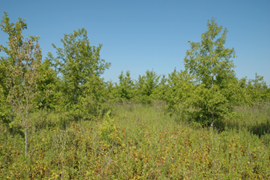
Temperate broadleaf forests occupying river floodplains of the southern United States are rich in tree species diversity, with various species of bottomland oaks (Quercus spp. L.) often comprising a primary overstory component in these forests across the region. Comprehensive research to support development of seeding as a method for artificially regenerating bottomland oaks began in the early 1980s and quickly advanced to produce reliable practices for establishing oak-dominated stands. Large-scale forest restoration was initiated across the region during the late 1980s at which time bottomland oak seeding practices were adapted for broad scale use due to their relatively low costs. This manuscript presents a synthesis of basic bottomland oak ecology, factors leading to degradation of bottomland oak sites and stands, favored techniques and practices for restoring bottomland oak forests through seeding, factors that limit success and impose risks upon seeding projects, and silvicultural principles for seeding bottomland oaks in the southern United States.
Downloads
References
Allen JA (1990) Establishment of bottomland oak plantations on the Yazoo National Wildlife Refuge Complex. South J Appl For 14:206–210. https://doi.org/10.1093/sjaf/14.4.206 DOI: https://doi.org/10.1093/sjaf/14.4.206
Baker JB, Broadfoot WM (1979) A practical field method of site evaluation for commercially important southern hardwoods. USDA Forest Service General Technical Report SO-26, New Orleans, LA, USA.
Battaglia LL, Minchin PR, Pritchett DW (2002) Sixteen years of old-field succession and reestablishment of a bottomland hardwood forest in the Lower Mississippi Alluvial Valley. Wetlands 22:1–17. https://doi.org/10.1672/0277-5212(2002)022[0001:SYOOFS]2.0.CO;2 DOI: https://doi.org/10.1672/0277-5212(2002)022[0001:SYOOFS]2.0.CO;2
Bonner FT (2008) Fagaceae – beech family, Quercus L. oak. In: Bonner FT, Karrfalt, RP (eds) and Nisley RG (ed coord), The woody plant seed manual. USDA Forest Service Agriculture Handbook 727, Washington DC, USA, pp 928–938.
Bonner FT, Vozzo JA (1987) Seed biology and technology of Quercus. USDA Forest Service General Technical Report SO-66. New Orleans, LA, USA.
Burns RM, Honkala BH (tech coords) (1990) Silvics of North America Volume 2. Hardwoods. USDA Forest Service Agriculture Handbook 654, Washington DC, USA.
Cai W, Borlace S, Lengaigne M, Van Rensch P, Collins M, Vecchi G, Timmermann A, Santoso A, McPhaden MJ, Wu L, England MH, Wang G, Guilyardi E, Jin FF (2014) Increasing frequency of extreme El Niño events due to greenhouse warming. Nature Climate Change 4:111–116. https://doi.org/10.1038/nclimate2100 DOI: https://doi.org/10.1038/nclimate2100
Cannon JB, Peterson CJ, Godfrey CM, Whelan AW (2023) Hurricane wind regimes for forests of North America. Proc Nat Acad Sci United States America 120(42):e2309076120(1–8). https://doi.org/10.1073/pnas.2309076120 DOI: https://doi.org/10.1073/pnas.2309076120
Cunningham K, Taylor E, Barber B, Holley G, Blazier M (2019) Forestry herbicide prescriptions – Western Gulf Region. University of Arkansas, Division of Agriculture Research and Extension, MP553.
DeSteven D, Schweitzer CJ, Hughes SC, Stanturf JA (2015) Afforesting agricultural lands in the Mississippi Alluvial Valley (USA): effects of silvicultural methods on understory plant diversity. In: Holley AG, Connor, KF, Haywood JD (eds) Proceedings of the 17th Biennial Southern Silvicultural Research Conference. USDA Forest Service, Southern Research Station, e-General Technical Report SRS-203. Asheville, NC, USA, pp 29–35.
Gardiner ES (2014) Outlook for Mississippi Alluvial Valley forests: a subregional report from the Southern Forest Futures Project. USDA Forest Service, Southern Research Station, General Technical Report SRS-201. Asheville, NC, USA. https://doi.org/10.2737/SRS-GTR-201 DOI: https://doi.org/10.2737/SRS-GTR-201
Gardiner ES, Hodges JD, Fristoe TC (2004) Flood plain topography affects establishment success of direct-seeded bottomland oaks. In: Connor KF (ed) Proceedings of the 12th Biennial Southern Silvicultural Research Conference. USDA Forest Service, Southern Research Station, General Technical Report SRS-71. Asheville, NC, USA, pp 581–585.
Gardiner ES, Stanturf JA, Schweitzer CJ (2004) An afforestation system for restoring bottomland hardwood forests: biomass accumulation of Nuttall oak seedlings interplanted beneath eastern cottonwood. Rest Ecol 12:525–532. https://doi.org/10.1111/j.1061-2971.2004.00396.x DOI: https://doi.org/10.1111/j.1061-2971.2004.00396.x
Groninger JW, Aust WM, Miwa M, Stanturf JA (2000) Growth predictions for tree species planted on marginal soybean lands in the Lower Mississippi Valley. J Soil Water Conserv 55:91–95. https://doi.org/10.1080/00224561.2000.12457314 DOI: https://doi.org/10.1080/00224561.2000.12457314
Hodges JD (1995) The southern bottomland hardwood region and brown loam bluffs subregion. In: Barrett JW (ed) Regional silviculture of the United States. John Wiley & Sons, Inc, New York, USA, pp 227–269.
Hodges JD (1997) Development and ecology of bottomland hardwood sites. For Ecol Manag 90:117–125. https://doi.org/10.1016/S0378-1127(96)03906-0 DOI: https://doi.org/10.1016/S0378-1127(96)03906-0
Hunter RG, Faulkner SP, Gibson KA (2008) The importance of hydrology in restoration of bottomland hardwood wetland functions. Wetlands 28:605–615. https://doi.org/10.1672/07-139.1 DOI: https://doi.org/10.1672/07-139.1
Johnson RL (1981) Oak seeding—it can work. South J Appl For 5:28–33. https://doi.org/10.1093/sjaf/5.1.28 DOI: https://doi.org/10.1093/sjaf/5.1.28
Johnson RL (1983) Nuttall oak direct seedings still successful after 11 years. USDA Forest Service, Southern Forest Experiment Station, Research Note SO-301, New Orleans, LA, USA. https://doi.org/10.2737/SO-RN-301 DOI: https://doi.org/10.2737/SO-RN-301
Johnson RL, Krinard RM (1985) Oak seeding on an adverse field site. USDA Forest Service, Southern Forest Experiment Station, Research Note SO-319, New Orleans, LA, USA. https://doi.org/10.2737/SO-RN-319 DOI: https://doi.org/10.2737/SO-RN-319
Kennedy HE, Nowacki GJ (1997) An old-growth definition for seasonally wet oak-hardwood woodlands. USDA Forest Service, Southern Research Station, General Technical Report SRS-8, Asheville, NC, USA. https://doi.org/10.2737/SRS-GTR-8 DOI: https://doi.org/10.2737/SRS-GTR-8
Löf M, Castro J, Engman M, Leverkus AB, Madsen P, Reque JA, Villalobos A, Gardiner ES (2019) Direct seeding to restore oak (Quercus spp.) forests and woodlands. For Ecol Manag 448:474–489. https://doi.org/10.1016/j.foreco.2019.06.032 DOI: https://doi.org/10.1016/j.foreco.2019.06.032
MacDonald PO, Frayer WE, Clauser JK (1979) Documentation, chronology, and future projections of bottomland hardwood habitat loss in the Lower Mississippi Alluvial Plain: Basic report. Vol. 1, US Fish and Wildlife Service, Washington, DC, USA.
McNulty S, Myers JM, Caldwell P, Sun G (2013) Chapter 3 – Climate change summary. In: Wear DN, Greis, JG (eds) The Southern Forest Futures Project: technical report. USDA Forest Service, Southern Research Station, General Technical Report SRS-178, Asheville, NC, USA, pp 27–43. https://doi.org/10.2737/SRS-GTR-178 DOI: https://doi.org/10.2737/SRS-GTR-178
Meadows JS, Nowacki GJ (1996) An old-growth definition for eastern riverfront forests. USDA Forest Service, Southern Research Station, General Technical Report SRS-4, Asheville, NC, USA https://doi.org/10.2737/SRS-GTR-4 DOI: https://doi.org/10.2737/SRS-GTR-004
Miwa M, Schoenholtz SH, Hodges JD, Kennedy HE Jr (1993) First-year results of bottomland oak reestablishment in alluvial soils of the Lower Mississippi Valley. In: Brissette JC (ed) Proceedings of the Seventh Biennial Southern Silvicultural Research Conference. USDA Forest Service, Southern Forest Experiment Station, General Technical Report SO-93, New Orleans, LA, USA, pp 73–79.
Muller RA, Grymes, III JM (1998) Regional climates. In: Messina MG, Conner WH (eds), Southern forested wetlands ecology and management. Lewis Publishers, Boca Raton, FL, USA, pp 87–101. DOI: https://doi.org/10.4324/9780429342653-4
NOAA (2023) National Oceanic and Atmospheric Administration, National Centers for Environmental Information, 1991–2020 Normals. http://www.ncdc.noaa.gov/cdo-web/datatools/normals. (last accessed 15 May 2024).
NRCS (2020) Soil Survey Staff, USDA, Natural Resources Conservation Service. Web Soil Survey. http://websoilsurvey.sc.egov.usda.gov/. (last accessed 15 May 2024).
Oliver CD, Burkhardt EC, Skojac DA (2005) The increasing scarcity of red oaks in Mississippi River floodplain forests: Influence of the residual overstory. For Ecol Manag 210:393–414. https://doi.org/10.1016/j.foreco.2005.02.036 DOI: https://doi.org/10.1016/j.foreco.2005.02.036
Ouyang Y, Jin W, Grace JM, Obalum SE, Zipperer WC, Huang X (2019) Estimating impact of forest land on groundwater recharge in a humid subtropical watershed of the Lower Mississippi River Alluvial Valley. J Hydrol: Regional Studies 26:100631(1–13). https://doi.org/10.1016/j.ejrh.2019.100631 DOI: https://doi.org/10.1016/j.ejrh.2019.100631
Putnam JA, Bull H (1932) The trees of the bottomlands of the Mississippi River Delta region: their distribution, occurrence by site and cover type, utilization in the Delta, and the distinguishing characteristics of the principal and most common species and groups of species. USDA Forest Service Southern Forest Experiment Station, New Orleans, LA, USA. DOI: https://doi.org/10.5962/bhl.title.127714
Shoch DT, Kaster G, Hohl A, Souter R (2009) Carbon storage of bottomland hardwood afforestation in the Lower Mississippi Valley, USA. Wetlands 29(2):535–542. https://doi.org/10.1672/08-110.1 DOI: https://doi.org/10.1672/08-110.1
Stanturf JA, Schoenholtz SH (1998) Soils and landforms. In: Messina MG, Conner WH (eds) Southern forested wetlands ecology and management. CRC Press Lewis Publishers, Boca Raton, FL, USA, pp 123–147. https://doi.org/10.4324/9780429342653-6 DOI: https://doi.org/10.4324/9780429342653-6
Stanturf JA, Gardiner ES, Hamel PB, Devall MS, Leininger TD, Warren ME Jr (2000) Restoring bottomland hardwood ecosystems in the Lower Mississippi Alluvial Valley. J For 98(8):10–16. https://doi.org/10.1093/jof/98.8.10 DOI: https://doi.org/10.1093/jof/98.8.10
Stanturf JA, Conner WH, Gardiner ES, Schweitzer CJ, Ezell AW (2004) Recognizing and overcoming difficult site conditions for afforestation of bottomland hardwoods. Ecol Restor 22:183–193. https://doi.org/10.3368/er.22.3.183 DOI: https://doi.org/10.3368/er.22.3.183
Stanturf JA, Goodrick SL, Outcalt KW (2007) Disturbance and coastal forests: A strategic approach to forest management in hurricane impact zones. For Ecol Manag 250:119–135. https://doi.org/10.1016/j.foreco.2007.03.015 DOI: https://doi.org/10.1016/j.foreco.2007.03.015
Sternitzke HS (1976) Impact of changing land use on Delta hardwood forests. J For 74(1):25–27. https://doi.org/10.1093/jof/74.1.25 DOI: https://doi.org/10.1093/jof/74.1.25
Strickland MS, Callaham MA Jr, Gardiner ES, Stanturf JA, Leff JW, Fierer N, Bradford MA (2017) Response of soil microbial community composition and function to a bottomland forest restoration intensity gradient. Appl Soil Ecol 119:317–326. https://doi.org/10.1016/j.apsoil.2017.07.008 DOI: https://doi.org/10.1016/j.apsoil.2017.07.008
Vines RA (1960) Trees, shrubs and woody vines of the southwest. University of Texas Press, Austin, TX, USA.
Downloads
Published
Issue
Section
License

This work is licensed under a Creative Commons Attribution 4.0 International License.
Authors who publish with this journal agree to the following terms:
- Authors retain copyright and grant the journal right of first publication with the work simultaneously licensed under a Creative Commons Attribution License CCBY that allows others to share the work with an acknowledgement of the work's authorship and initial publication in this journal.
- Authors are able to enter into separate, additional contractual arrangements for the non-exclusive distribution of the journal's published version of the work (e.g., post it to an institutional repository or publish it in a book), with an acknowledgement of its initial publication in this journal.
- Authors are permitted and encouraged to post their work online (e.g., in institutional repositories or on their website) prior to and during the submission process, as it can lead to productive exchanges, as well as earlier and greater citation of published work (See The Effect of Open Access).
How to Cite